Nonwoven Filtration Systems for High-Speed Lines: Reclaim Space and Reduce Maintenance at Techtextil North America

Nonwovens manufacturers are under constant pressure to produce more with the resources they already have. Production volumes keep increasing, energy costs remain unpredictable, skilled maintenance resources are limited, and cleanliness expectations continue to grow across hygiene, medical, and filtration-grade applications. Yet for many plants, one constraint hasn't moved with the rest of the business: available plant space.
While production lines continue to run faster and more efficiently, many facilities rely on drum filtration systems to manage fiber fly, lint, and fine particulate dust, and for many production environments, that remains a dependable choice. For plants where floor space and maintenance intervals are the bigger priority, compact filtration technology is worth a closer look as production scales up.
Why Nonwovens Manufacturers Are Rethinking Filtration
Filtration decisions today carry more weight than fiber fly and dust removal alone. They factor into how nonwoven producers protect product cleanliness, simplify maintenance, optimize plant layouts, and support long-term operational growth. The shift is happening industry-wide: fabric filter and dust collection systems are seeing sustained global growth right now, driven largely by plants retrofitting and modernizing existing filtration rather than building new. That's the exact position most nonwoven manufacturers and converters walking Techtextil's aisles are in.
Across production operations, the pressures are remarkably similar:
- Increasing line speeds and production demand without expanding the facility
- Rising operating and energy costs
- Matching the right filtration technology to line speed and floor space, especially as facilities scale up
- Production interruptions on continuous, high-speed lines caused by servicing activities
- Limited floor space for new machinery, converting equipment, and future expansion
- Growing cleanliness expectations for hygiene, medical, and filtration-grade nonwovens
- Regulatory requirements to limit worker exposure to airborne fiber dust on the production floor
Downtime carries real weight on a nonwoven line. Every hour a filtration system is down for service, or every square foot it occupies instead of production or converting equipment, is money the plant is already spending without getting output for it. Fiber fly and lint that escape containment can also settle on product, raising contamination risk on hygiene and medical lines where cleanliness is non-negotiable, and sustained exposure is also a workplace air quality concern that plants are required to manage.
These pressures are pushing manufacturers to look beyond traditional filtration technology. Rather than simply replacing existing equipment, plants are investing in filtration systems that improve operational efficiency while creating long-term value: reducing maintenance requirements, improving space utilization, and enabling easier plant modernization.
Matching Filtration Technology to Your Line's Priorities
Drum filters have been the standard in nonwovens for decades. With floor space and maintenance intervention becoming the priority, compact filtration technology recovers valuable production and converting floor space, simplifying retrofit projects, and reducing maintenance intervention, while still supporting the same reliability and long-term cost of ownership goals as a well-run drum filtration system.
Luwa offers a full range of filtration technology to match your plant's priorities, including the Rotary Drum Filter, the RPB Rotary Pleated Belt Filter for continuous, high-speed production environments and super absorbent polymers (SAP), and the MCV Multi Cell Filter for space-constrained modernization projects.
RPB Rotary Pleated Belt Filter: Reliable Filtration for Continuous Production
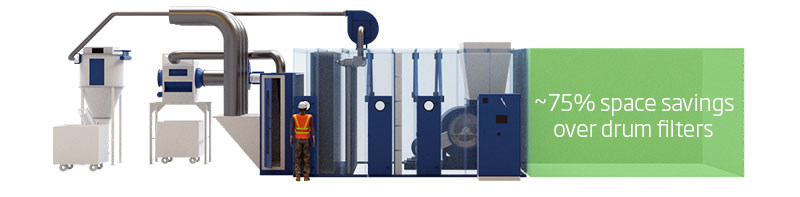
In high-speed nonwoven production, filtration performance directly affects line efficiency, housekeeping, and overall plant productivity. The RPB Pleated Belt Filter is engineered to provide continuous, dependable fiber fly and lint removal while minimizing operator intervention, so plants maintain consistent operating conditions through extended production cycles instead of stopping for manual attention.
Here's what that means for your operation:
- Continuous belt operation delivers stable filtration throughout the production cycle, not just between servicing intervals, so fiber fly removal never lags behind line speed
- Reliable, low-intervention operation keeps operators focused on production instead of filter upkeep
- The pleated belt design extends filter life, lowering long-term consumable costs
- Energy-efficient operation keeps consumption in check even under continuous, multi-shift use
- Consistent filtration supports a cleaner production environment, which matters most on hygiene, medical, and filtration-grade lines
- On diaper and feminine hygiene converting lines, RPB is engineered to capture Super Absorbent Polymer (SAP) dust alongside fiber, at high efficiency
For manufacturers running production lines around the clock, the result is stable machine performance, lower downtime, and a reduced total cost of filtration.
MCV Multi Cell Filter: More Production Space Without Expanding Your Building
.jpg)
For many nonwoven manufacturers, available floor space is one of the biggest constraints to future growth, especially in converting and finishing areas. The MCV Multi Cell Filter addresses this directly with a compact static filter wall that cuts installation footprint by up to 70% compared with conventional drum filters, freeing up space that can go toward additional machinery, improved workflow, or future expansion.
Here's what that means for your operation:
- Up to 70% smaller footprint than a conventional drum filter reclaims real production capacity
- A compact footprint built to fit into existing plant layouts, so most retrofits need minimal structural modification
- An automatic cleaning system reduces routine maintenance demands on your team
- Reclaimed floor space translates directly into flexibility for expansion and modernization planning
- Efficient filtration performance helps lower overall operating costs
By significantly reducing the filtration footprint, the MCV helps you modernize your existing facility without investing in costly building extensions.
RPB vs. MCV: Which Filtration System Fits Your Line?
| RPB Pleated Belt Filter | MCV Multi Cell Filter | |
| Best for | Continuous, high-speed fiber fly and lint removal | Space-constrained modernization projects |
| Filter Design | Pleated belt with continuous operation | Compact static filter wall |
| Maintenance | Reduced through continuous belt cleaning | Reduced through automatic cleaning |
| Ideal Application | Multi-shift, high-speed production lines and super absorbent polymers (SAP) | Retrofit and modernization projects (converting, finishing) |
| Space Requirement | Up to 75% less than conventional drum filters | Up to 70% less than conventional drum filters |
Many nonwoven manufacturers evaluate both systems side by side depending on layout, shift patterns, and expansion plans. Our engineering team can help match the right system, or combination, to your production line.
Why Nonwovens Manufacturers Choose Luwa
More than supplying equipment, Luwa works closely with customers to understand their production requirements and develop solutions that deliver measurable business value. Manufacturers choose Luwa for:
- Specialized air engineering expertise built around real nonwoven line layouts and production patterns
- Installations across global nonwovens markets
- Solutions customized to each plant's constraints rather than a one-size-fits-all system
- Energy-efficient technology designed for long-term operating performance
- Engineering, commissioning, and lifecycle support beyond the initial installation
- Strong experience specifically in retrofit and modernization projects
Whether you're planning a new installation or upgrading an existing facility, Luwa helps you build a filtration system that supports today's production needs while preparing for tomorrow's growth.
Why Visit the Luwa Booth 1331 at Techtextil North America
A visit to the Luwa booth is more than a product demonstration. It's an opportunity to discuss your production challenges with specialists who understand nonwoven air engineering and the realities of operating modern, high-speed nonwoven lines. Our solutions are especially relevant for attendees working in Techtextil's Medtech segment (hygiene and medical nonwovens) and Indutech segment (industrial filtration media), where fiber and dust control have the biggest impact on product quality and compliance.
Our team can help you:
- Compare the RPB and MCV systems side by side
- Understand how compact filtration can recover valuable production and converting space
- Review your plant layout and discuss possible retrofit approaches
- Evaluate opportunities to reduce maintenance requirements
- Identify the most suitable filtration solution for your production environment
Whether you're planning a modernization project, evaluating filtration options, or looking to recover valuable production space, visit Luwa at Booth 1331 and speak with our nonwoven air engineering specialists.
Together, we'll explore practical solutions that help reduce maintenance, optimize plant layouts, and support more efficient nonwoven manufacturing for years to come.