The Air Engineering Gap at ITMA ASIA + CITME 2026: Why China's Textile Mills Are Looking at Fans and Data Differently
Walk through most textile mills in China, India, or Southeast Asia and the investment priority is obvious: faster looms, finer spinners, automated material handling. The machinery on the production floor gets the capital expenditure, the engineering attention, and the boardroom scrutiny. The air system rarely gets the same treatment. It is treated as infrastructure. As overhead. As something that either works or does not.
That assumption is expensive.
In a typical spinning mill, axial flow fans consume up to 55% of total HVAC electrical energy. Push into weaving, and the figure climbs to 75%. These fans do not run intermittently. They run continuously, across shifts, across seasons, across years. A marginal improvement in their efficiency does not deliver a marginal saving. It reshapes the operating cost structure of an entire department. Yet most mills still run aluminium impeller blades designed decades ago. The blades are heavy. The aerodynamic profiles are limited by casting constraints. The efficiency curves degrade silently as filters load and duct pressures shift. No one notices until the electricity bill arrives.
This is the problem Luwa is addressing at ITMA ASIA + CITME 2026. Not with a single product, but with an integrated platform that treats air as a strategic production input rather than an unmanaged utility.
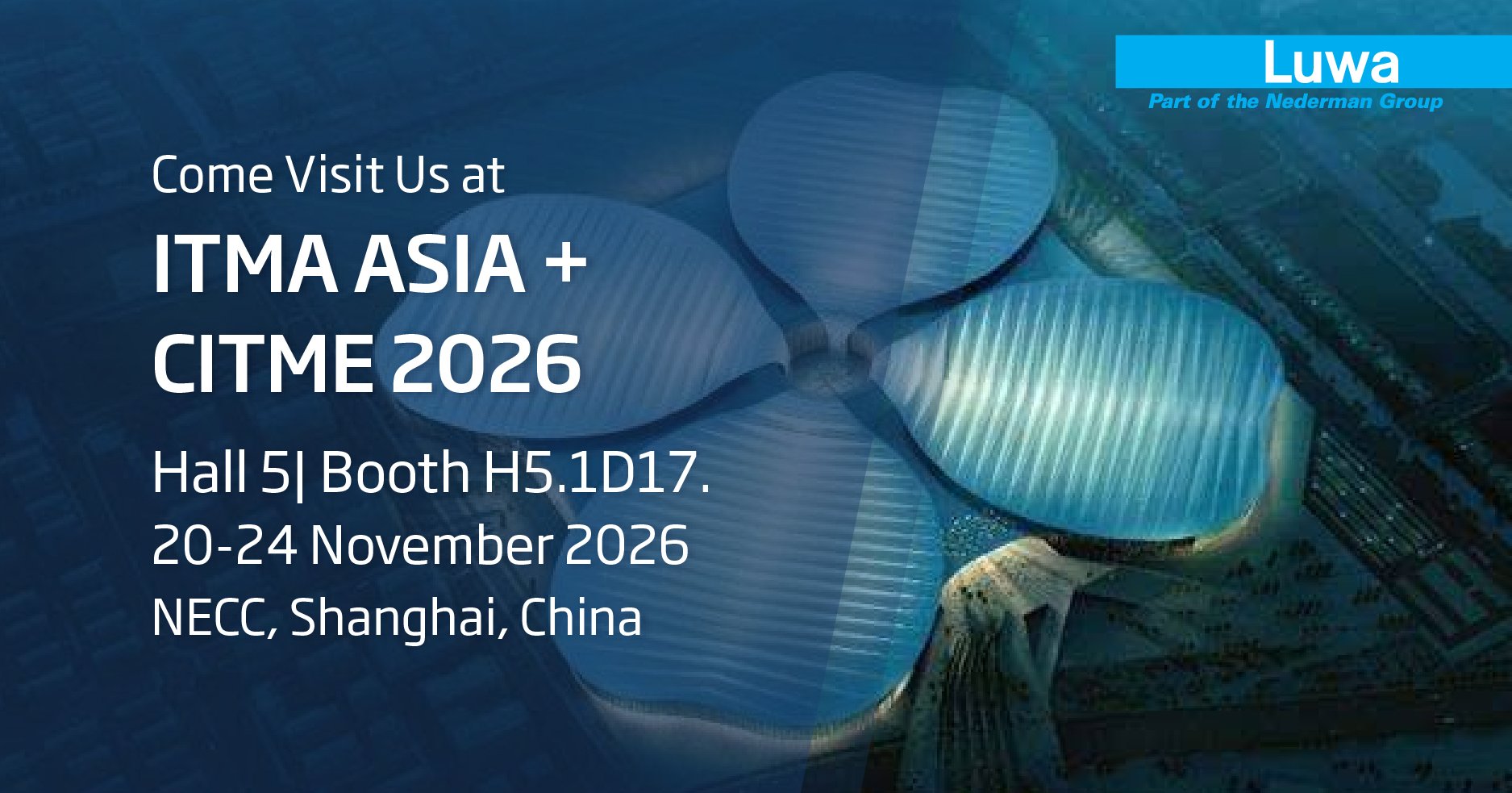
Luwa Air Engineering. Hall 5, Booth H5.1D17. 20-24 November. National Exhibition and Convention Center, Shanghai.
Pillar One: When the Blade Itself Becomes the Upgrade
The Luwa B800CF Axial Flow Fan is not an incremental improvement on conventional fan design. It is a different category of engineering. The impeller blades are manufactured from Hybrid Long-Carbon-Fibre-Compound (LCF), a material that allows for geometries and precision impossible with formed or cast aluminium. Through an advanced injection moulding process, the blades achieve thinner leading and trailing edges, a sickle-shaped aerodynamic profile, and dimensional consistency that reduces turbulence and drag.
The material properties translate directly into operational physics:
- Weight reduction: 60%+ vs aluminium. Lower rotating mass cuts motor load, bearing stress, and mechanical fatigue on the full drive train. The fan needs less energy to start and less energy to hold speed.
- Aerodynamic efficiency: sickle profile, optimized surface finish. More air moved per kilowatt-hour, less turbulence, lower noise for both regulatory compliance and operator working conditions.
- Adjustable pitch at installation. One fan model tunes to the exact airflow and static pressure a department needs, spinning or weaving, without compromise.
- Wider operating range. Efficiency holds as real-world conditions drift: filter loading, machine speed changes, seasonal humidity swings. Not just at the design point, but across the operating envelope.
- Direct retrofit compatibility. Installs into existing Luwa systems without structural rebuilds, removing the capital risk and downtime tied to infrastructure replacement.
The blades are also corrosion-resistant for humid, dusty textile environments, and the carbon fibre manufacturing waste is repurposed into reinforced plastic materials, aligning with circular production principles.
Pillar Two: Visibility as a Competitive Tool
A more efficient fan establishes a lower energy baseline. But baselines erode. Filters load. Setpoints drift. Seasonal changes push systems outside their tuned parameters. Without visibility, a mill discovers these inefficiencies after they have already accumulated cost.
DigiControl 7 is Luwa's response. It is an industrial PLC-based control platform purpose-built for textile air systems, not adapted from generic building management.
- ±2.5% RH humidity control. The margin between consistent yarn quality and costly variation.
- Multi-user, multi-PLC access. Up to five concurrent users and monitoring across multiple production halls from one platform.
- Six months of trend history. Patterns surface before they turn into failures.
- Alarm manager and energy metering. Deviations flagged in real time; energy tracked daily instead of once a month at the invoice.
- High-resolution HMI. Clear graphical status indicators let any operator read system health at a glance, regardless of technical depth.
Luwa Insight extends this beyond the control room:
- Cloud dashboards, any device. Plant managers overseeing multiple lines or sites review performance without standing at a panel.
- Predictive analytics. Filter differential pressure, temperature, and humidity trends flag maintenance needs before failure.
- Automated reporting. Recurring documentation ready for management review and sustainability compliance.
Luwa Assist completes the architecture:
- Remote specialist review. Luwa's air engineering specialists review plant data remotely and bring recommendations backed by evidence already in hand, not guesswork.
The Multiplier: Why One Without the Other Leaves Money on the Table
Carbon fibre blades and digital controls are not separate purchases. They are complementary layers of a single system.
The blade reduces the physical energy required to move air. The control system optimizes when and how that air moves. The monitoring layer ensures the efficiency persists by catching drift before it compounds. The expert support layer ensures the system is continuously tuned rather than installed and forgotten.
This is Intelligent Air Engineering: precision hardware, optimized by intelligent software, validated by continuous data, and supported by specialist expertise.
A mill that installs efficient blades without digital monitoring will capture initial savings, then slowly lose them to undetected degradation. A mill that installs digital monitoring without efficient hardware will see exactly how much energy its inefficient fans are wasting. The full value requires both.
At ITMA ASIA + CITME 2026, Luwa is demonstrating this integration live. Not as a concept. As a working system.
What This Means for Different Roles
- For the Mill Owner or CEO: The dominant energy consumer in your HVAC system is now optimizable. With documented case study data and a retrofit path that avoids infrastructure replacement, the B800CF offers a defensible capital decision. The digital layer turns that decision into a sustained advantage rather than a one-time gain.
- For the COO or Operations Head: DigiControl 7 and Insight convert air system management from reactive to predictive. You will know about filter degradation before it affects climate stability. You will see energy drift before it hits the monthly report. You will have six months of trend data to support operational decisions.
- For the Engineering or Technical Director: The B800CF is not a theoretical material science project. It is a direct retrofit with adjustable pitch, three standard sizes, and compatibility with existing Luwa infrastructure. The digital ecosystem integrates with your current network architecture without proprietary lock-in.
- For the Energy or Sustainability Manager: The Gebr. Otto case study provides a reference model for your own savings calculations. The CO2 reduction is quantifiable. The digital reporting automates the documentation you need for compliance and stakeholder communication.
- For the Maintenance Manager: Predictive analytics based on differential pressure trends mean you replace filters based on condition, not calendar. The lighter blade assembly reduces bearing wear. The remote expert support gives you access to specialist diagnostics without waiting for a site visit.
The Booth Experience: Hall 5, H5.1D17
At the National Exhibition and Convention Center in Shanghai, Luwa has built a working consultation space, not a product display.
What you will do there:
- See the B800CF running. The fan operates in its housing at full speed. You'll see the blade profile, the sickle shape, and the injection-moulded finish through the frame, and our engineers can point out exactly what the 60%+ weight reduction changes about how it runs.
- Review your energy profile. Bring your current fan specifications or electricity data. Our engineers will estimate your specific savings potential using proven benchmarks.
- See DigiControl 7 walked through. Our engineers will take you through the HMI, the parameters, and how ±2.5% RH automation works.
- See Insight explained. Our team will walk you through the dashboard views, predictive alerts, and automated reporting using real examples from installed systems.
- Discuss your layout. Bring your mill configuration. Our applications engineers will map how filtration, humidification, distribution, and control integrate across your specific departments.
ITMA ASIA + CITME 2026 | 20 to 24 November 2026 | National Exhibition and Convention Center, Shanghai
Luwa: Hall 5 - Booth H5.1D17
If energy cost, operational visibility, or production consistency are on your 2026 agenda, this is where to bring the specifics.